Showing posts with label public space. Show all posts

Wednesday, April 6, 2022

Public transport as public space: fostering everyday equality among strangers

Every now and again, I give a little 10 minute 'class' for "Self-Improvement Wednesday" with Richard Glover on ABC Radio 702. I've been trying to use these classes to encourage listeners to think about some of the habits and infrastructures that we often take for granted in city life. In the past I've done episodes on the physical geography of the internet, on the role of advertising in public space, and on the urban mobility politics of vertical transportation.

The most recent episode was about public transport as public space. Here's the script we worked from - which draws a fair bit from the Everyday Equalities book I worked on with Ruth Fincher, Helga Leitner and Valerie Preston that came out in 2019.

Public transport as public space: fostering everyday equality among strangers

Crowd standing next to the first electric train in Wynyard Station, Sydney, 1932. Source: National Library of Australia


Discussions about public transport tend to focus on its ability (or inability!) to get us efficiently from A to B. But what about the journey itself? Train carriages, station platforms and other transport like buses and ferries are also some of the most-used public spaces in our cities – many thousands of us share these intimate spaces with strangers every day. What everyday rules and habits have we developed to make that work? What happens when they break down? And how can we create the kinds of positive atmospheres that will make public transport truly accessible for all?

**

Sydney’s railway network: spreading us out and packing us in 

Sydney’s urban geography has been shaped by its railways, in more ways than one. 

The story we usually tell about our train network is that it allowed the people to find more personal space in suburban homes away from the more densely packed inner city. Advocating for the electrification and extension of the suburban railway network, Bradfield told a conference of town planners in 1917 that it would allow workers “to reside further afield and enjoy fresh air and sunlight”. 

But as well as letting us spread out, those trains also packed people together in their carriages. In Sydney and other cities where train networks were growing, this was a new – and somewhat confronting – social experience. One of the great early sociologists of the industrial city, Georg Simmel, wrote in 1908:
Before the development of buses, trains and streetcars in the nineteenth century, people were quite unable to look at each other for minutes or hours at a time … without talking to each other. 

Equality or incivility?

Reacting to this new experience, observers at the time veered between optimism and pessimism about what it would mean for urban populations. 

In France in the 1850s, economist and politician Constantin Pecqueur waxed lyrical about the new solidarity and equality that might emerge through train travel:
By causing all classes of society to travel together and thus juxtaposing them into a kind of living mosaic of all the fortunes, positions, characters, manners, customs, and modes of dress that each and every nation has to offer, the railroads quite prodigiously advance the reign of truly fraternal social relations and do more for the sentiments of equality that the most exalted sermons of the tribunes of democracy. 
But others were much more pessimistic.

It wasn’t just that train services in many countries tended to stratify passengers by class into different compartments and carriages. The monotony of the daily commute, the press of the crowd in the morning and afternoon peak, made some worry that people were being treated as mere goods to be efficiently moved through space by this new mechanical form of mass transportation.

Here in Sydney, writing in 1923 around the time of the first train electrification, an editorial writer for The Sun worried that overcrowded trains had:
boxed us up into a straggling mass and killed our natural Instinct to be polite. We have to scramble and fight for the means of getting home and the man who steps aside and says: 'After you,' is the man who walks and finds his late arrival hard to explain. 
By the 1930s, things were getting so crowded during peak hours that train carriages were refitted to remove seats and make more room for ‘strap-hangers’ to squeeze into the standing areas of vestibules and aisles.

Both perspectives, I think speak to the different possibilities of train travel.

Learning to share the space of the train: the unwritten rules of ‘civil inattention’ and physical accommodation

Certainly, the strategies we’ve developed to cope with the intimacy of sharing a carriage with strangers might not initially look too promising as practices of ‘fraternity’ and ‘equality’. 

Trains, along with other public transport spaces, are places where we’ve learnt to practice the art of ‘civil inattention’. In the early days of train travel, reading a newspaper or book was the classic ‘involvement shield’. Now, we have our smart phones to keep us amused during our commute and to keep us socially, if not physically, distanced from our fellow passengers. 

Share the confined public space of the train carriage with strangers also involves learning a bunch of physical skills. There’s all the little things we do with our bodies to carve out our own personal space, to make space for others. We also learn to read the non-verbal cues of our fellow passengers seeking to get past us to alight the train, and to avoid lurching or falling when the train starts and stops. 

When all this works, the train carriage becomes a microcosm of the city’s multiculture: Pecqueur’s lovely idea of the train carriage as a “living mosaic” of urban diversity is apt. We rub shoulders with all manner of strangers in a kind of everyday equality.  That experience of equality is sustained by the notion that the train is for anyone, and that we all have a part to play in making it work – even if our relationships with fellow passengers are fleeting, and our actions and solidarities are unspoken.

When public space becomes hostile space

Of course, solidarity among strangers on the train can also break down. I’m sure listeners can name their pet peeves! There are minor infractions like people taking up too much space. And much more seriously, some passengers can become targets of aversive behaviour, harassment, intimidation and violence – sometimes on the basis of their gender, their sexuality, their visible faith, the language they are speaking, or the colour of their skin. 

Interestingly, the very devices that we use as ‘involvement shields’ are now frequently being used by bystanders to witness, disrupt and shame such behaviours. There’s been a growing trend of passengers capturing ‘racist rants’ on their smart phones and re-asserting the equality of the public space.

From hostility to festivity and solidarity?

Not all disruptions of our habitual ways of being together on the train are bad. 

French anthropologist Marc Auge described the train as a space of “collectivity without festival and solitude without isolation”. I love that description! But the collectivity on the train can occasionally be a little festive, and sometimes solitude makes way for connection.

Think of the festive atmosphere that can take hold of a train carriage during special events, like footy fans taking the train to a big game at Olympic park. Or think of people coming to one another’s aid, through small acts of kindness like assisting someone with a stroller or vacating a seat, or through spontaneous expressions of care and solidarity like the anti-racist #I’llRideWithYou social media hashtag that was reposted hundreds of thousands of times following the Martin Place hostage-taking in 2014. 

Tipping the balance towards equality and solidarity: too many sticks, not enough carrots?

What can the transport authorities themselves do, to tip the scales from hostility towards solidarity and equality – especially when they can’t be in every carriage, all the time?

Of course, operating and maintaining the public spaces of trains and buses plays a big role. A special shout out here to all the operators, guards and cleaners who have kept our system going during the difficult last two years of the pandemic.

So too does designing the space to be accessible for all – there are still dozens of stations across Sydney that are only accessible by stairs, without lifts.

Beyond that, there’s been considerable focus on naming and policing the ‘unwritten rules’ of being together. On Sydney trains, there’s plenty of signs and posters telling us what not to do. Don’t put your feet on the seats. Don’t be a ‘hogger’ or a ‘loud talker’ or a “tosser”. And there are surveillance cameras watching over us, and transit officers patrolling trains and stations. 

But if those are the sticks, what about some carrots?

Urban designer Jan Gehl says that a good public space is like a good party – once you get there, you don’t want to leave. I’m not sure that little analogy quite works for a train!

But it does point to the role that care, hospitality and activation might play in making these public spaces work.

A few things come to mind. I like the sign that the Human Rights Commission developed with one of the major bus companies for use in Melbourne a few years ago – it’s simple and positive message was “This bus is for everyone”. It’s welcoming, not censorious.

In other cities I’ve visited, train carriages have been adorned with commissioned poetry and artworks. In Chicago a few years ago, I did find myself hanging around on a train platform much longer than planned – a local blues band were set up at one end, and as well as the music being great, they were keeping an eye on the comings and goings at the station. In Sydney a couple of years ago, on Make Music Day, bands were set up on inter-city train carriages – the opposite of a quiet carriage!

Public Space, Public Transport, and the Public Good

In the scheme of things, when our infrastructure challenges are so great, perhaps investing in these kinds of initiatives seems trivial. 

But taking trains and other public transport seriously as public spaces can actually have the effect of making them more accessible to people who need them to get around.

You can have as many train lines as you like, but if they’re not spaces where everyone feels welcome, where strangers can establish and nurture positive strategies for being together in their difference as equals, then people won’t use them. 

For public transport to serve the public good, it needs to work as public space. And this is something that both operators and we passengers always need to work at.


Thursday, April 16, 2020

We don’t know what we’ve got till it’s gone – we must reclaim public space lost to the coronavirus crisis

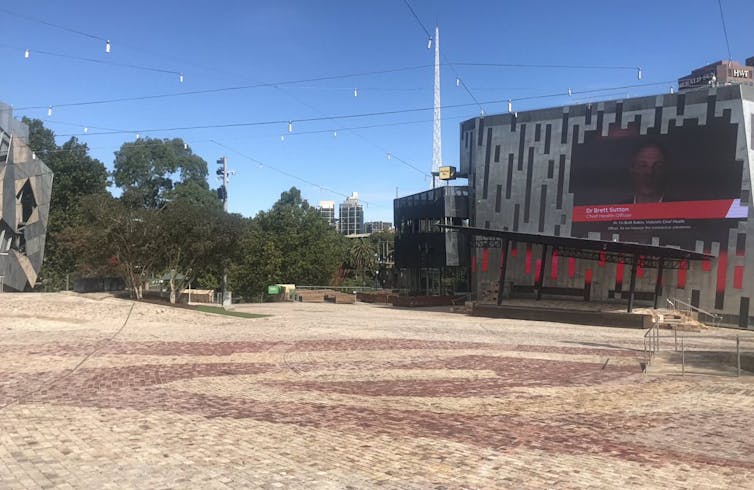
At a deserted Federation Square in Melbourne, the big screen broadcasts this message: ‘If you can see this, what are you doing? Go home.’ Cassie Zervos/Twitter
Kurt Iveson, University of Sydney

Authorities have imposed significant restrictions on the size, purpose and location of gatherings in public space to slow the transmission of COVID-19. The massive impacts of these escalating restrictions over the past two months show us just how significant public spaces are for the life of our cities. A longer-term concern is the risk that living with these measures might normalise restrictions on, and surveillance of, our access to public space and one another.

Right now, public health is the priority. But access to public spaces was already significantly and unjustly restricted for many people before the coronavirus pandemic. Current restrictions could both intensify existing inequalities in access and reinforce trends towards “locking down” public space.


Read more: Public spaces bind cities together. What happens when coronavirus forces us apart?


We must ensure these restrictions do not become permanent. And once the crisis is over, we also should act on existing inequitable restrictions.

Restrictions have inequitable impacts

Unless public health interventions are enacted with an awareness of their profoundly uneven consequences, we may well “flatten the curve” in ways that add to existing inequalities and injustices.

Research suggests restrictions on public space have greater impacts on people who have less access to private space. People without stable homes, and those with restricted access to domestic space, tend to live more of their lives in public. Public space restrictions have far greater consequences for these people.

We can see this relationship very clearly: the restrictions are paired with instructions to stay at home. This applies to everyone. But, while it’s inconvenient for some, it’s impossible for others.

It’s certainly the case for the homeless. It will also be true of others. For instance, students may be living in crowded conditions in shared, family or informal accommodation, with no access to quiet private space for study.

This is why researchers and activists are demanding restrictions on public space be accompanied by provisions to make such people’s lives less precarious. Suggested measures include a moratorium on evictions and safe and free accommodation for rough sleepers.


Read more: Homelessness and overcrowding expose us all to coronavirus. Here's what we can do to stop the spread


Research also shows us restrictions on public gatherings and public space were a feature of everyday urban life for many people well before physical distancing came in.

Young people of colour who gather in small groups in public spaces frequently report being stopped, searched and moved on by police and security guards. People on low incomes were already excluded from commercial public spaces like cafes and shopping malls. People asking for spare change or leafleting passers-by were barred from quasi-public spaces that are subject to special restrictions. People who cannot climb stairs were unable to use basic public infrastructure, like train stations, that lacks lift or ramp access. The list goes on.

These pre-existing restrictions were the product of exclusion and injustice. We should not have tolerated this before the crisis and it demands our renewed attention after the crisis.

We also know authorities responsible for regulating public space, including police, tend to enforce rules and restrictions selectively. In New South Wales and Victoria, police chiefs have been explicit that police will use their discretion in enforcing current restrictions.

The problem is this use of discretion can be informed by stereotype and prejudice. For communities who already felt unfairly targeted by police, statements about the use of discretion will be far from reassuring.


Read more: How city squares can be public places of protest or centres of state control


‘Temporary’ really must be temporary

We must guard against a common tendency for temporary measures to become more permanent. Some of the extraordinary powers given to police to break up gatherings and fine people who fail to observe restrictions have been time-limited. But having been used once for a particular problem, the risk is such powers might be enacted more often in future.

We have seen this happen with closures of public space for commercial events. Each closure is justified as being only temporary, but such closures have become increasingly common. The cumulative effect is a creeping commercialisation of public space.

One can also see how “temporary” experiments with digital surveillance to slow contagion could become permanent. Tech corporations are offering analyses of mobile phone and other data to profile public activity and to trace the movements and contacts of individuals who have contracted the coronavirus.

It’s the latest step in the datafication of urban everyday life. This process erodes privacy and grants more and more power to corporations and governments. It is easy to see how “contact tracing” could also be applied to protesters or stigmatised minorities.


Read more: Darwin's 'smart city' project is about surveillance and control


Normalisation of restrictions must be resisted

Coronavirus-related restrictions are obvious to us because they have been imposed so rapidly. However, we should reflect on how other restrictions have become normalised precisely because they happened gradually, making them less visible and contested.

For example, over the past decade we have seen a creeping “gating” of a public spaces like parks and school ovals. Free access to those spaces has been greatly reduced when they are not in use for organised education or sports.


Read more: Pushing casual sport to the margins threatens cities' social cohesion


Interestingly, as urban authorities try to provide large populations with access to public spaces in which they can maintain recommended physical distance, some existing restrictions are being rethought. Cities are closing streets to cars to give pedestrians more space rather than having to crowd onto footpaths. It will be interesting to see if such measures persist once physical-distancing restrictions are lifted.

Let’s hope our experience of the inconvenience and frustration of restricted access to public space will translate into a more widely shared determination not only to end these restrictions when the health crisis is over, but also to act on the unjust exclusions and restrictions that were already a feature of urban life.

As with so many other aspects of our society, it is not enough simply to go back to how things were before. We must ensure our public spaces are not unjustly restricted when the next crisis comes along.The Conversation

Kurt Iveson, Associate Professor of Urban Geography and Research Lead, Sydney Policy Lab, University of Sydney

This article is republished from The Conversation under a Creative Commons license. Read the original article.

Monday, November 5, 2018

Outdoor Advertising and Public Space


So, there was controversy here in Sydney a couple of weeks ago about the NSW Government's decision to force the Opera House to display an advertisement for a horse race.

I wrote an opinion piece for the Sydney Morning Herald about the broader issue of advertising and its impacts on public space.

Premier Gladys Berejiklian's intervention to insist the Sydney Opera House allow blatant Racing NSW advertising on its sails is objectionable for many reasons.
Most worryingly, it signals a new intensification of the ongoing privatisation of our public spaces through advertising. The surfaces of our city are being remade as advertising space before our very eyes. ...
You can read the rest of the piece here.

There was a great protest down at the Opera House on the night in question - you can read about that here.

I've had a bee in my bonnet about advertising in public space for a while now ... and published an article in Antipode a few years ago about the global outdoor advertising industry. You can find that here (email me if you're interested and have a hard time accessing it).

And there's also a piece about hacking outdoor advertising and the decommodification of public space in the new book I've been involved with writing, Sydney We Need to Talk!.

New book - SYDNEY WE NEED TO TALK!


I'm excited (and proud!) to announce the publication of a new book that I've been involved in pulling together.

It's called Sydney -- We Need to Talk!

It has been written by a group of folks at the University of Sydney -- geographers, plannings, political scientists, visual artists, staff and students -- who have been meeting every week to talk about our work on the politics of urbanisation. We're all either thinking about Sydney and/or thinking from Sydney. There are essays on decommodification, dispossession, democratisation, degrees, domains, dimensions, domesticity and digitalisation (we started riffing with d-words, and couldn't stop).

Each essay is co-authored, and while each essay features work on Sydney, it also travels somewhere else. We bring Sydney into dialogue into other cities where we're working, including Jakarta, London, Barcelona, Hong Kong, New York and beyond.

The book was designed by artist Wendy Murray, who has also responded to each essay with a series of illustrations.

You can find out more about the book and its making, and download a free copy of the book, at the website we've set up here.

The list of contributors is: Brittany Betteridge, Pratichi Chatterjee, Leah Emmanuel, Amy Fairall, Bradley Garrett, Mini Graff, Kurt Iveson, Rupert Legg, Sophia Maalsen, Marilu Melo, Wendy Murray, Madeleine Pill, Dallas Rogers, Jathan Sadowski, Alistair Sisson, Amanda Tattersall, Sophie Webber

Wednesday, August 17, 2016

Pokémon GO and public space

 Pokémon GO players gather at Peg Patterson Park in Rhodes, Sydney. Source: ABC

In an earlier post here, I argued that Pokémon GO involves players in a form of 'playbour', because playing the game involves the production of geospatial data that is owned and can be traded by the game's creator, Niantic.

In this post, I want to take a look at a related set of issues that have arisen with the rapid and massive popularity of this game. If Pokémon GO has figured out a way to encourage and then profit from our explorations of public space, what else does the game have to teach us about public space in our digitally 'augmented' urban playgrounds?

**

Pokémon GO is an 'augmented reality' app, and is by far the most popular application of this technology that we've seen. 'Augmented reality' (AR) makes use of internet connectivity, location awareness and cameras on smartphones to allow people to view digital images and information that have been layered onto the 'real' physical environment.

A few years ago, AR was going to be the next big thing in digital tech. But things didn't quite go as predicted, and more recently, we started seeing more and more commentary on the failure of AR to live up to that hype. Now, with the massive popularity of Pokémon GO, it seems to be back with a bullet.

At least three fascinating issues concerning Pokémon GO and public space have arisen in the past few weeks, and I think they illustrate some broader issues that are pertinent for discussions of augmented reality in urban environments.

1. Where are the Pokémon? On the uneven distribution of digital 'augmentation' across public spaces

So, are there Pokémon in your neighbourhood? Of course, as the game is rolled out across different markets at different times, this will depend in the first instance on whether or not the game has come to your country! (Africa, you're still waiting! You too, India and China. CNET are keeping an updated list of countries where you can (officially) play the game here.)

But even if the game is available in your city, we are seeing that some neighbourhoods are full of Pokémon and PokéStops, while in other places there are less to find.

This interesting article from the US by Christopher Huffaker makes some very interesting observations about the locations of key sites or 'portals' in an augmented reality game called Ingress. This matters for our discussion because Ingress is a predecessor to Pokémon GO, was developed by the same operator (Niantic), and its geospatial data has been used to set locations for key sites in Pokemon GO like PokéStops and Gyms. Huffaker argues there are fewer portals in predominantly African-American neighbourhoods of large US cities like Detroit, New York and Chicago. Researchers at the Urban Institute in Washington DC have done their own maps, and have come to similar conclusions.

Now, no-one is suggesting that a group of nasty people working for Niantic sat down and plotted out an uneven, racialised distribution of Pokémon GO sites to make it harder to play in predominantly African-American neighbourhoods. But that's the whole point. When crowds are used to source data, the data is only as inclusive as the crowd. And because Ingress tends to be played by a quite specific kinds of people, Pokémon data reflects those demographics.

More broadly, we might also observe that when algorithms are used to turn such data in geospatial information, the data is only as inclusive as the parameters that have been coded for the algorithms. The algorithmic nature of the game information is also most likely the explanation for the various stories appearing about 'inappropriate' game locations, like memorials and some secure sites -- not to mention suburban parks that might not have the infrastructure to cope with hoards of people trying to hang out there (more on that one below).

For most of us, it's very difficult to get a grip on the way such algorithms work. Even if we could get corporations or governments to share their code, those lines of code only make sense to those with the specialist skills to understand how they work. There's a growing literature on the role of algorithms in the governance of cities and populations. That literature suggests that as algorithms become ever more important in informing and even automating decision-making and resource allocation, we might want to know a little more about how they work, and how their injustices can be made visible and contested. The discussion about the location of key sites in Pokémon GO certainly illustrates the kinds of things that are at stake.

There are two more points to note about the location of important sites in the game. First, the geography of the game is likely to change as more sponsorship deals are done between Niantic and those seeking to lure players to their location. As has been widely reported, the first of these major deals was done with McDonalds in Japan, and many more are set to follow - Niantic's John Hanke says that this is his preferred means of raising revenue. Shops and advertisers can also spend money to buy and then set lures for players. So, for all the hype about the way that this game is encouraging people to explore their urban environment, we might want to ask some questions about how those explorations are being guided as the digital geography of the game is further commercialised.

Second, a conflict has emerged between Niantic and a numbers of fan websites that had been providing real-time maps of Pokémon locations, by scraping data from the game. As reported by CNET and others, it appears that Niantic have found a way to prevent tracking sites like Pokevision accessing their locational data, and made a few legal threats to those sites while they are at it. The operators of Pokevision wrote an open letter to Hanke and Niantic about the shut down. Hanke and Niantic responded with a blog post claiming that they'd taken the action to reduce pressure on their servers, which have been melting down frequently. This conflict over the openness of the game's location data is an interesting one. This is a game operated by a commercial gaming company, so to what extent do the usual arguments about 'open data' apply? Interestingly, those running the tracking sites are arguing that their access should be maintained because it will enhance the playability of the game, especially while the tracking feature continues to have problems. This interesting conflict is to be continued, I'm sure...

2. Who can access the Pokémon? On uneven access to public space in cities of inequality

Not everyone who walks around a city staring at their phone searching for Pokémon will have the same experience of this 'play'. To play this game is to walk around an urban environment in search of Pokémon, PokéStops and Gyms. Indeed, the game also rewards you for the steps you take while playing it, with those steps helping you to hatch eggs. (A brilliant way to ensure that your geographical data can be captured, by the way ... but that's another story.)

Niantic and the game's supporters are talking up the social and the health benefits of this kind of play -- if millions of people are now out and about in their public spaces, exploring places they have never been, meeting other players and getting exercise at the same time, then everyone wins, right?

Well, sort of. Here's where Pokémon GO interacts with the broader politics of public space. As we know from decades of research on this topic, public spaces in our cities are not equally accessible to everyone.

Again in the United States, there has been some critical discussion about the experience of 'Pokémoning While Black'. In Iowa City, Faith Joseph Ekakite shared this account of being stopped and searched at gunpoint by police while playing the game in a park. Omari Akil wrote this widely-reported account of his unease while playing the game, fearing that Pokémon GO could be a death sentence for black men, given the on-going problem of police shootings in the US.

Not surprisingly, there has also been some discussion of the potential vulnerability of children playing the game, and the potential for them to be 'lured' to locations where they might be targeted for their smartphone or something else. Here,

There seems to have been less discussion of the gendered politics of playing Pokémon in public space. A recent report suggests that female players outnumber male players by a ratio of almost 2 to 1. If that's true, I'll admit that it challenges my own assumptions about the gendered nature of both gaming and public space.

In fact, this finding raises the question of whether Pokémon GO game play might actually help to address, rather than reinforce, some of the exclusionary aspects of public space that I've mentioned above. Anecdotally, some people playing the game tell me that it has given them and their friends a kind of 'license' to be in various places that they would not normally go, like parks and residential streets late at night. They say they can do so because they know there will be other people around also playing, and so places will be less scary than they might otherwise have been. Are the eyes on the screen are also 'eyes on the street', in a Jane Jacobs kinda way? Will this actually help to make public spaces more accessible, by being more used?

3. Whose infrastructure supports the game? On the public-private relationship in augmented urban spaces

Niantic provides the digital data and server infrastructure that enables people to play the game as they move around their environment. But as Pokémon GO turns the streets and parks and malls of the city into a playground, who provides the playground? The game takes-for-granted the existence of 'physical' public spaces and their infrastructures, and makes no particular contribution to their provision or maintenance.

On the surface, this doesn't seem unreasonable -- after all, public space is notionally meant to be accessible to all, right? So why shouldn't it be available for play (or playbour)?

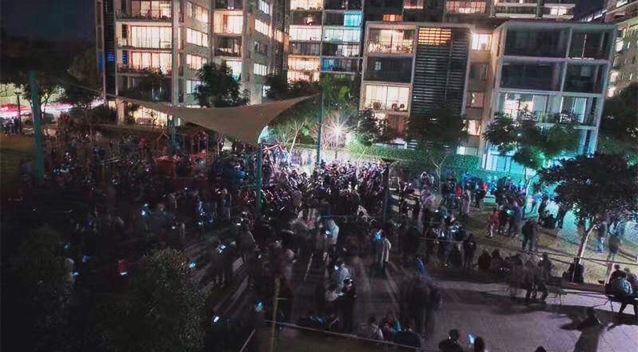
However, it's clear that in some instances, the popularity of the game has actually put some public spaces under considerable pressure. Here in Sydney, an everyday park in suburban Rhodes that most people had never visited or even heard of was inundated with hundreds (perhaps thousands) of Pokémon GO players in search of rare Pokémon that were concentrated in the area. Word of the bounty on offer in the park spread quickly through social media, so this was a classic example of a nimble, digitally-connected crowd in formation and action.

Residents complained of noise and litter. At one point, they took to throwing water bombs from their balconies late at night to try to clear the park. Police were called, and they issued parking infringements to try to move people on.

As several players pointed out, there were no fights, no violence, no crime, and this is meant to be public space ... so what's the problem?

But it's also true that the crowds had some impacts on the park. The picture below accompanied an article on one local website about the issue -- the park does seem kinda messed up.


While maintaining local parks is one of the responsibilities of public authorities, and while those parks are there to be used by 'the public', this little episode demonstrates some of the complex geographical dimensions of urban publicness

I think we do need to resist the idea that this park somehow 'belongs' to the 'local' public, and the associated logic that people coming from 'elsewhere' is a problem in itself. Nor would I want to see any kind of 'users pays' logic be introduced to park use in Sydney, or elsewhere.

But what of the private commercial entities who are making lots of money, but who are not actually making any contribution to support the urban environment that supports their game? Yes, there is socialisation going on here, but there is also commercialisation (something can be two things at once!). And where there's commercialisation, it's not necessarily unreasonable for the public authorities to seek some kind of contribution or compensation. Money for growing trees doesn't grow on trees, if you know what I mean.

Earlier this year, Evgeny Morozov made the case in a piece for the Guardian that the tax-dodging and tax-minimising practices of huge digital corporates like Uber and Google was actually contributing to the hollowing out of state capacity to fund public services like transport. It's a question worth asking: while Pokémon GO might be enhancing some people's experience of public space, but should we expect some financial contribution from the game's owners to sustaining the playground for their very profitable game?

**

So, there you go. Across these three sets of issues, we can see that the game's popularity throws up some new questions about public space in networked cities, but also draws us into some very old questions about the city's streets and their accessibility. It's only a game, I know. But as our experience of public space is increasingly mediated through digital connectivity, it's a game that does have something to teach us about how the urban experience is being transformed through collisions of the digital and the urban.

In finally finishing this piece, I've also come across a few other interesting articles specifically on the issue of Pokémon GO and public space that are worth checking out:

Sunday, August 14, 2016

McKenzie Wark on Judith Butler on Assembly and The Street

Street sculpture and tents, Hong Kong 2014. Source: Mapping the Umbrella Movement


McKenzie Wark has written a great review of Judith Butler's 2015 book "Notes Toward A Performative Theory of Assembly" over at Public Seminar.

Butler's book includes a chapter called 'Bodies in Alliance and the Politics of the Street', that appeared online a couple of years back as a talk given by Butler in the wake of events like Tahir and Occupy. Once I got over my initial jilted geographer's reaction of 'hey, you realise a few other folks have been thinking about public space and politics since Hannah Arendt?', I got heaps out of the Butler piece (it's *Judith Butler* writing about public space and politics, after all!). In particular, I really like the way she works with (and past) Arendt's approach to the 'space of appearance', focusing attention on the 'infrastructure' that is produced and sustained to support that appearance: as she puts it, "the material supports for action are not only part of the action, but they are also what is being fought about".

Anyway, one of the passages in Wark's review that really stuck out for me was this:
For Butler, “the media have entered into the very definition of the people.” (20) Might it not rather be the other way around? There is a sort of latent Platonism at work here, where the bodies gathered in and as a body, come first, and their mediated double second. But surely it is the other way around in any modern polity. The media are the primary space; public squares and so forth are sets for media performances. One cannot simply add media onto some fantasy of the Greek polis and call it modern politics. The thing to occupy is media time; the way to do it is to take space. It is not the case that “the media extends the scene.” (91) The scene is a retroactive production of media. If an assembly gathered and nobody noticed, did it make a sound?
This is a great provocation about the relationship between the urban and the media in public formation and politics. I can get with the idea that maybe the bodies don't come first, prior to some subsequent mediation, and I think Wark's point here is really important. But I'm not sure I can get with the follow-up claim Wark makes here that: "the thing to occupy is media time; the way to do it is to take space", and that argument that urban public spaces are now primarily "sets for media performances".

Sure, many occupations and assemblies are indeed 'staged' with their 'screening' in mind, and media narratives clearly shape and frame actions staged in the streets -- so I agree that efforts to claim media space/time are a constitutive element in the production of many political events in public spaces, not a secondary or subsequent process.

But in the occupations that we have witnessed across this decade, I think there are plenty of things going on that don't conform to this formulation either. Sometimes, the bodies assembled together are constantly moving between practices that sustain the physical space of occupation, and practices that reach out beyond that space in the process of representation and claim-making. 'Urban' and 'media' spaces are mixed together in different combinations to achieve these dual ends. Just as some actions are clearly staged in a physical public space in a manner calculated to find an audience via mass/niche/social media as Wark argues, so too various media are put to work in the service of maintaining what Butler calls the 'infrastructure' of assembly/occupation (eg via social media call-outs for resources/food, defence against police, etc). Theses processes of social reproduction in an assembly/occupation are not exclusively undertaken just to sustain the space that can occupy media time. They are also frequently understood as prefigurative experiments with different (more just) ways of being together, and therefore as political ends in themselves (for some great images of this in action at Occupy Wall St, see Alison Young's blog post over on Images to Live By).

So, as I tried to argue in this short piece written a little while back, I think it's a dead end to get into an argument about 'which comes first?', the city (ie Butler's bodies in a physical geography) or the media (ie Wark's mediated presence with its virtual geography). An approach that focuses on interaction and co-production seems much more promising.

Wark's review comes under the title "what the performative can't perform", meaning that for him Butler's frame is too focused on embodied performativity at the expense of a consideration of the performativity of infrastructure (including media). But in Publics and the City, when I was trying to think through the co-constitution of embodied and mediated forms of 'being public', I actually found some work in Performance Studies very helpful - in particular, Philip Auslander's 1999 book Liveness - Performance in a Mediatized Culture. Writing to a performance/theatre studies audience, he argued against the idea that live theatre has more 'radical' potential than mediatised performance on the basis of its 'liveness' and the embodied co-presence of performers and their audience. Rather, he insists, the very idea of 'liveness' is a function of mediatisation, precisely because "mediatisation is now explicitly and implicitly embedded within the live experience" (eg think about the way live events incorporate media, the way they are staged with mediation in mind, etc). In Auslander's book, this passage really stuck out for me:
any distinction [between live and mediatised performances] needs to derive from careful consideration of how the relationship between the live and the mediatized is articulated in particular cases, not from a set of assumptions that constructs the relation between live and mediatized representations a priori as a relation of essential opposition.
I think this is a great warning against any theoretical prioritisation of embodied co-presence or mediatisation.

In this vein, one of the points I took from Butler's book was her linking of bodies and media in assemblies. In noting that assemblies circulate via media, she also points out that:
there remains something localized that cannot and does not travel in that way; and the scene could not be the scene if we did not understand that some people are at risk, and the risk is run precisely by those bodies on the street. If they are transported in one way, they are surely left in place in another, holding the camera or the cell phone, face to face with those they oppose, unprotected, injurable, injured, persistent, if not insurgent. It matters that those bodies carry cell phones, relaying messages and image..." (9).
This passage brought a bunch of memories flooding back for me ... of sitting at my computer in Sydney, transfixed by the #ows twitter stream during the infamous march across the Brooklyn Bridge in which hundreds were arrested, half a world away. I was there in one sense, and they were with me ... but in another sense, of course, we really were worlds apart. Me, in a comfy office, reading live media accounts from people being violently blocked and arrested by police.

Now, Wark might say this is exactly his point (ie that those bodies were taking risks in public space precisely in order to capture media time). Fair enough. But I guess I feel as though taking a little of both Butler and Wark together could actually be quite fruitful for those of us trying to think through the urban/media interface in politics right now.

In any case, Wark's review is going to have me dipping back into some of his previous writing on media, vectoral power, etc. (I just read his latest book Molecular Red, which I loved for many reasons ... not least for some unexpected and evocative personal recollections on his time in the offices of the Communist Party of Australia back in the day when the green bans were in full swing!).

Tuesday, August 9, 2016

The Politics of Pokémon GO on The Stream

Right then, this was fun. The Sydney Morning Herald piece on Pokemon GO got picked up by the lovely people at The Stream on Al Jazeera, and I was just involved in an interesting panel discussion on the game and its politics.

The 30 minute discussion covered political appropriations of the game, the apparently racialised uneven distribution of PokeStops and Gyms in the game, the accessibility of public space, data privacy and monetisation, the present and future of augmented reality, and other interesting stuff.


Thursday, April 14, 2016

Nuit Debout

[Crickey, a year since the last post here! Time to get things going again...]

Protesters in the Place de la Republique, Paris. Image source: The Guardian


Twelve nights of protests and counting in Paris, under the Nuit Debout banner. There's a story in the Guardian here about the first week of protests. As with many other occupations that have taken place in the last five years or so, there's a really interesting process of care and social reproduction going on here - something that Setha Low and I have recently written a little about in a piece on public space and social justice.

Here's an interesting discussion of the movement on Al Jazeera, featuring one of my union comrades from the University of Sydney, Nick Riemer, who is in Paris right now....


Jacques Rancière and Étienne Balibar also offered statements of solidarity to the initial sit-ins, which you can find here.

Monday, June 2, 2014

Remembering Tiananmen Square: the 25th Anniversary of the June 4 massacre

Protesters in Tiananmen Square, Beijing, June 2 1989 (Source: Boston Globe)

4 June 1989 was the date on which the Chinese Government brutally smashed the occupation of Tiananmen Square in Beijing. The Square had been the target of protest since April of that year, in a pro-democracy protest initially led by students but which quickly gathered broader support. At times during these 6 weeks, the Square was filled with over 1 million people.

There will no doubt be plenty of anniversary articles written about these events to mark their 25th anniversary. Among them, novelist Ma Jian has written a great article for the Guardian about his experiences of the 1989 movement, and of the fate of some of his fellow protesters and the Chinese democracy movement in the years since.

Of course, the stories of historical events like this are always told through the lens of the present, and for me at least, it's hard not to think about Tiananmen in relation to other more recent pro- (and anti-) democracy occupations and demonstrations. Reading the article, passages like the following have a strong resonance with recent events:
The democracy protests were ... a spontaneous mass uprising, a jubilant national awakening, in which millions of students, workers and professionals gathered peacefully in public squares around the country for weeks on end to call for rights guaranteed to them by the constitution: freedom of speech, of the press and of assembly and freedom to elect their leaders – basic liberties that the west takes for granted. They were among the most orderly, restrained and self-disciplined protests the world has seen. Student marshals maintained crowd control; armies of volunteers distributed food and drink and provided free medical care. In the madness of 20th-century China, the Tiananmen protests were a moment of sublime sanity, when the individual emerged from the somnolent collective and found their true voice.
 In this atmosphere of freedom, people used their innate creativity and intelligence to challenge and question state power. Teenagers strummed Bob Dylan ballads around campfires and danced in the dark. The Beijing Symphony Orchestra brought its instruments to the square and gave an impromptu performance of Beethoven's Ode to Joy. Art students erected a replica of the Statue of Liberty right opposite the huge portrait of Chairman Mao on the square's northern edge. The student leader, Wu'er Kaixi, rebuked Premier Li Peng on national TV, dressed in striped pyjamas. In a makeshift Democracy University, professors gave seminars on Thomas Paine and the French revolution. When the government rejected pleas for dialogue, hundreds of students tied white bandanas around their heads and went on hunger strike. On 3 June, Liu Xiaobo, then a lecturer at the Beijing Normal University, staged his own hunger strike on the square with the economist Zhou Duo, the rock star Hou Dejian and party member Gao Xin, to protest against martial law and call for a peaceful transition to democracy.
Reading this great article reminded me of a couple of articles about Tiananmen Square that I read a long time ago as an undergraduate student by sociologist Craig Calhoun. I went back to those pieces briefly today, they make for fascinating reading.

Calhoun was actually in Beijing teaching at the time of the 'Beijing Spring'. One of his articles, "Revolution and Repression in Tiananment Square", provided a blow-by-blow account of the events that he witnessed (and in which he participated, alongside some of his students), along with some initial thoughts on the kinds of . He had some particularly interesting things to say about the improvisation of the repertoire of protest by the activists, and also about some of the different outcomes being sought by those protesting (including the relationship between 'the people', democracy, and economic inequality and development). Calhoun concluded this account by saying:

I think this movement is more likely to be one of the moments to which future Chinese democrats will look for inspiration, as they did this year to May 4, 1919. The inspiration of the movement will come partly from the very scale on which it happened, and partly from the common cause found for a while between students and intellectuals and workers and other citizens. However thinly it may be understood, the idea of democracy was spread. People demanded to be seen as citizens, not just as the government's masses. The citizens of Beijing (and other Chinese cities) showed that the totalitarian communism had not destroyed all institutional bases for social revolt; "society" was still separate from "state," at least to some extent – an extent growing because of Deng-era reforms. Perhaps most of all, however, the movement will be remembered for June 4, the day of infamy and massacre. It has brought about a massive loss of legitimacy for the government, and perhaps even more tellingly for the army. Over and over again students told me, "the People's Liberation Army will not shoot the people" They will not soon be so trusting again.

In a second article, "Tiananmen, Television and the Public Sphere", Calhoun argued that the protests had an 'intensive' and 'extensive' relationship to space. Here, he was seeking to understand the relationship between co-present and mediated forms of public address - in the Square and on the screen. The occupation of the Square was crucial:
When students seized Tiananmen Square, they seized a powerful, multivocal symbol. The Square spoke at once of the government, which used it to display its power, and of the people who gave the government authority by gathering there to acclaim official leaders. It linked the imperial palace to revolutionary monuments; it represented the center of China. By their actions the students transformed the meaning of the Square. Its popular side became dominant; this was the challenge to its power which the state well recognized. For a time, the students also made Tiananmen Square into a genuine place of public discourse. They met in small groups of friends for discussion, large audiences for speeches and even a more or less representative council for debating their collective strategy and carrying out self- government.
But as the title suggests, the article also focuses on the highly significant role of television, in both circulating narratives about crisis in China that influenced the Tiananmen movement, and in circulating stories and images of events to a global audience. As Calhoun noted, plenty of the actions of those in the Square were actually addressed towards that global audience - protesters were highly aware that some of the folks who were co-present with them in the Square were international journalists and photographers who would spread the word of their actions beyond both the city and China. Reflecting on that, Calhoun insisted that while face-to-face gatherings in 'public spaces' might be crucial to a democratic public sphere, democracy and public debate in large modern societies also depends upon mediation:
In modern large scale societies, ... democracy depends on the possibility of a critical public discourse which escapes the limits of face-to-face interaction.
This was an important message then, and still now.

But re-reading this article 25 years down the track, after the rise of social media, other passages stand out. In particular, there's an interesting discussion about the failure of the student movement to develop its own media. He noted the:
absence of some organized media 'voice of the students'. There was talk of forming a newspaper but none ever materialized. Hand printing presses were used to produce single sheet flyers, but there was no place for reporting news from the students' point of view, let alone a discussion journal. Even the 1979 Chinese democracy movement had formed several of these. Its 1989 counterpart was stronger on mobilization and found deeper popular sympathy, but it fell behind on both theory and communication. 
Of course, it is hard to imagine anyone coming to this conclusion about more recent insurgent movements, who had made use of social media to communicate amongst one another and to a broader public. As a growing number of folks are noting, there's an important relationship between urban and media spaces in these events that is being transformed but certainly not transcended with the use of social media.

So ... there's lots of food for thought in returning to these really powerful events (or in reading about them for the first time, if you are a younger reader!).


References

Craig Calhoun, 1989, "Revolution and Repression in Tianenmen Square", Society, Volume 26, Issue 6, pp 21-38.

Craig Calhoun, 1989, "Tiananmen, Television and the Public Sphere: internationalization of culture and the 'Beijing Spring' of 1989", Public Culture,  Number 2, pp. 54-71.

Tuesday, March 4, 2014

Review of Alice Arnold Film 'Electric Signs'

OK, so ... it's been a while between posts. I'm mostly blaming industrial action (which kept me too busy to actually write about politics for a while!) and holidays. And a little inertia. But it's time to get things rolling again.

First up, then, a quick link to something I've written elsewhere that might be of interest here -- it's a review of Alice Arnold's documentary film Electric Signs, which is coming out in the journal Antipode and (like all their book reviews) is available free online here.


It's a great film, which explores the ways in which new forms of screen-based signage are transforming the public domain in cities around the world. Given my on-going fascination with outdoor advertising and its impact on the possibilities of urban public address, I found the film really interesting.

And as I say in the review, one of my favourite scenes in the movie features New York artist Jason Eppink, who has found a beautiful way to hack the screen advertising on the New York subway ... check out a video about his pixelator project below.


Wednesday, June 19, 2013

"The voices of the street": the protests in Brazil


Protesters fill the streets in Rio de Janeiro. Source: The Guardian

"The voices of the street want more citizenship, health, transport, opportunities...": so said Brazilian President Dilma Rousseff, in response to several days and nights of protests by hundreds of thousands of people across a number of cities in Brazil.

I'm currently in the middle of writing a piece in response to Paul Mason's book Why It's Still Kicking Off Everywhere for City ... and while I've got my issues with some bits of the book, it's also hard not see recent events in Turkey and now in Brazil as further evidence to support some of his claims about the manner in which things are indeed still 'kicking off' in lots of places as various crises unfold.
Of course, as Mason is first to admit, different instances of contemporary mass protest each demand their own analysis. In Brazil, the grievance that seems to have been the spark for protests was a raise in bus fares, but clearly the protesters are articulating wider grievances about policing, public services, and spending on the up-coming Football World Cup (would it be wrong for me to say 'Go, Socceroos!' at this point?)

So, as with the recent post on Turkey, here are a few quick links to follow for some more information and analysis.

As ever, the Guardian has been a great source of information for me: you can find a page with links to their coverage of the protests, including reportage, analysis, and pictures/videos here.

Marcelo Lopes de Souza, a Professor in the Department of Geography at the Federal University of Rio de Janeiro, has been publishing some of his work on insurgent social movements in Brazilian cities in English in City and elsewhere. In his 2012 piece for City "Panem et Circenses or The Right to the City (Centre) in Rio de Janeiro" is a great piece for understanding the source of tensions about policing, spending, and displacement that now seem to be spilling onto the streets. He notes in that piece that:
In Rio de Janeiro, the dispute between the favela residents and the sem-teto [squatter] movement on the one side, and the interests linked to the ‘revitalisation’ of the harbour and down-town areas on the other, currently has everything to do with the municipal administration’s gradual implementation of the ‘revitalisation’ project christened Porto Maravilha (‘Marvellous Port’) along with the ‘slum upgrading’ programme Morar Carioca. The implementation of both the Porto Maravilha project and the Morar Carioca programme is taking place in the context of a very repressive policy named by the municipality as Choque de Ordem (‘Shock of Order’). What is in fact going on is the fostering of gentrification and increasing social control on a large scale within the framework of a very conservative urban regime, supported by the state government of Rio de Janeiro and even by the self-professed left-wing federal government under both President Lula da Silva (2003 – 10) and President Dilma Rousseff (2011 – present). The situation has become increasingly tense since 2009.
For a while now, I've also been meaning to blog about James Holston's 2009 piece "Insurgent Citizenship in an Age of Global Urban Peripheries". It's kinda awesome. I still hope to write on it in more detail at some point ... but in light of recent events in Brazil and beyond, it seemed appropriate to share this passage:
"although insurgent urban citizenships may utilize central civic space and even overrun the center, they are fundamentally manifestations of peripheries. In so far as the urban civic square embodies an idea of centrality and its sovereignties, its architectural design, institutional organization, and use represents the hierarchies, legalities, segregations, and inequalities of the entrenched regime of citizenship that the insurgent contests. The forces of centrality are entrenched in the civic square by design and that entrenchment establishes the terms of an official public sphere. Insurgent movements may adopt these terms to frame their protests—property rights, urban infrastructure, justice, even motherhood, for example. But whereas the center uses the structuring of the public to segregate the urban poor in the peripheries and to reduce them to a “bare life” of servility, the very same structures of inequality incite these hinterland residents to demand a life worthy of citizens.
My point is that it is not in the civic square that the urban poor articulate this demand with greatest force and originality. It is rather in the realm of everyday and domestic life taking shape in the remote urban peripheries around the construction of residence. It is an insurgence that begins with the struggle for the right to have a daily life in the city worthy of a citizen’s dignity. Accordingly, its demands for a new formulation of citizenship get conceived in terms of housing, property, plumbing, daycare, security, and other aspects of residential life. Its leaders are the “barely citizens” of the entrenched regime: women, manual laborers, squatters, the functionally literate, and, above all, those in families with a precarious stake in residential property, with a legal or illegal toehold to a houselot somewhere far from elite centers. These are the citizens who, in the process of building and defending their residential spaces, not only construct a vast new city but, on that basis, also propose a city with a different order of citizenship.
Both pieces above examine the nature of centre-periphery relationships in urban life in Brazil. I'm nowhere near educated enough to know just who has hit the streets in the past few days and whether they are from the 'peripheries' ... but the centres are certainly being overrun, to powerful effect. What kind of jolt might this produce in Brazilian politics?

[Note 1: of course, neither author considers the 'periphery' to be a simple geographical designation...]

[Note 2: if you can't access full copies of these articles, get in touch...]


Thursday, June 6, 2013

Making Space Public in Istanbul (with update 11/6/13)

Turkey protests day five: People in Gezi park
Protesters gather in Gezi Park, Istanbul. Source: The Guardian

Apologies for the long radio silence here ... our industrial campaign for a fair enterprise agreement at the University of Sydney has been soaking up any spare time for luxuries like blogging!

However, I've spent a little time this morning reading about recent events in Istanbul, so figured I could at least share some links.

Plans to redevelop Gezi Park in the centre of the city (including a shopping mall, of course!) have catalysed a significant mobilisation, with mass demonstrations involving hundreds of thousands of people and occupations of the park and nearby Taksim Square, and violent confrontations with police.

As is often the case with such events, the park and plans for its redevelopment have come to stand in for disagreements on wider political and economic issues.

The Guardian has been reporting on events, and you can find several articles and multi-media resources here

The London Review of Books Blog has also posted a couple of very interesting pieces which dig a little deeper into the wider political and economic context in which these events are taking place - one by Kaya Genç is here and another by Çağlar Keyder is here. The latter especially speaks of the 'Islamist neoliberalism' of Erdoğan's Government in Turkey. This seems to be producing quite particular 'regimes of publicness' (to borrow Staeheli and Mitchell's term), with restrictions on the sale of alcohol, memorialisation of controversial religious figures, and commercialisation all impacting on public space and helping to generate interesting alliances in opposition including religious and ethnic minorities, trade unions, intellectuals, and the secular urban middle classes.

The academic journal Environment and Planning D: Society and Space has also put together a 'virtual issue' on the background of these events in Turkey, with free access to five articles until the end of August.

And there is a fantastic piece reflecting on the events by Timur Hammond and Elizabeth Angell called Is Everywhere Taksim: Public Space and Possible Publics here. This piece offers a very interesting analysis of the kinds of new publics that are in formation in the protests, and their relationship to the wider public sphere and the kinds of publics that have been constructed through the infrastructure projects of the Erdoğan Government.

The interaction between urban and media/digital space in such events is of particular interest to me at the moment. Apparently in this conflict, police have been using mobile phone jammers to prevent protesters using their devices to coordinate their movements. Turkey's mainstream media has been accused of siding with the government by not covering the events. Nevertheless, social media has once again proved important in circulating information and images of the events in a manner that has contributed to their rapid escalation. In response, the prime minister has apparently branded Twitter 'a menace to society', and some have been arrested in Turkey for spreading false information and incitement to disorder on social media.

The image below is one that has apparently been widely re-circulated through social media - it's an image of Ceyda Sungur, an academic from the town planning department at Istanbul's Technical University, being pepper-sprayed at short range by a police officer. You can read about her and the photo here.


Ceyda Sungur is showered with pepper spray. Source: The Guardian